
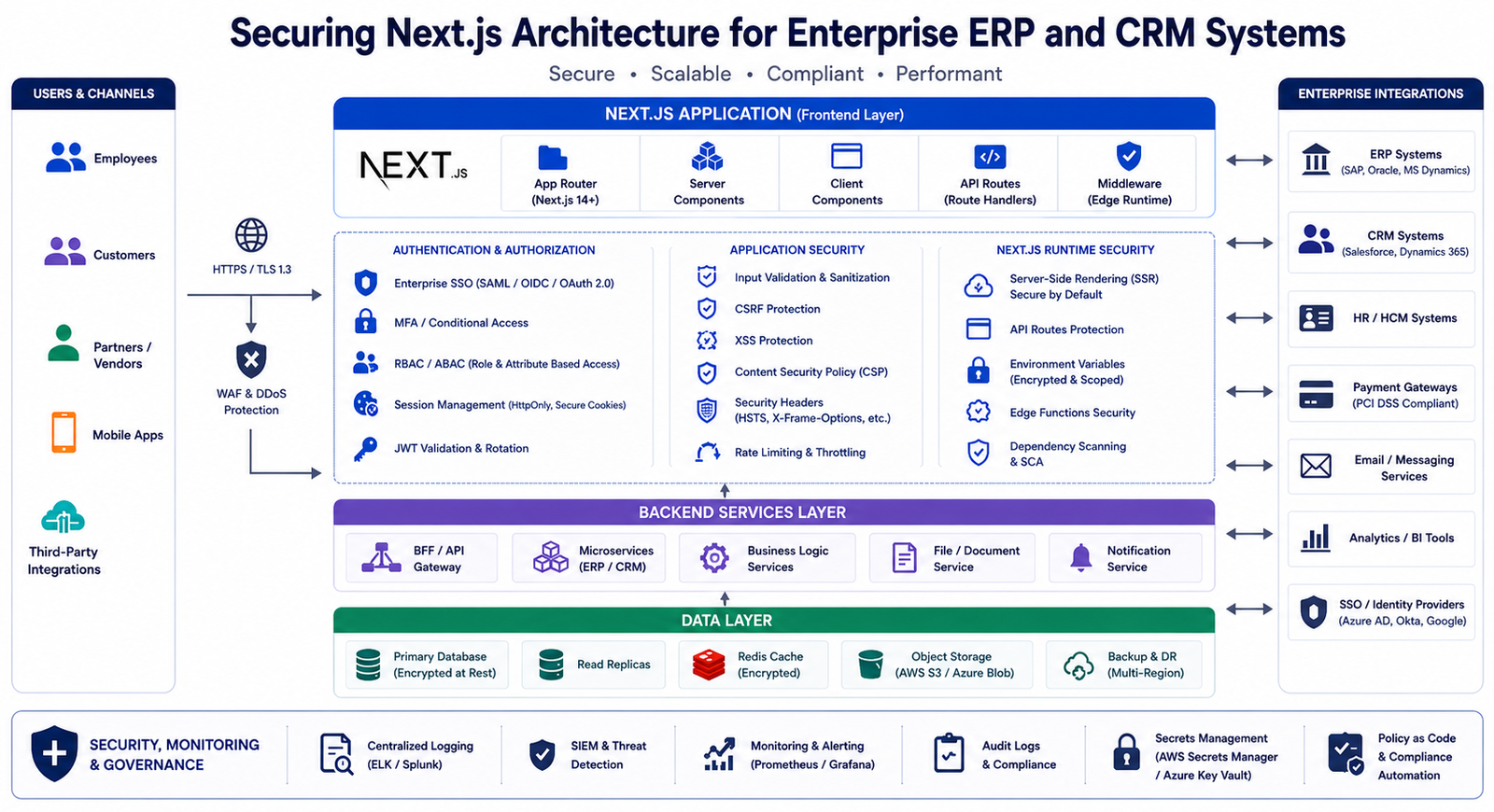
How to Secure and Scale Next.js Architecture for Enterprise ERP and CRM Systems
Building an enterprise-grade ERP or CRM system requires balancing two critical pillars: uncompromised security and instantaneous performance. As more organizations migrate to Next.js for its exceptional Full-Stack capabilities and seamless deployment workflows, engineering teams often run into a common pitfall—treating a modern React architecture with traditional monolith security mentalities.
When managing sensitive corporate databases, payroll systems, and multi-tenant workflows, basic client-side validation isn't enough. You need a rock-solid, framework-level blueprint.
Let’s dive into how you can bulletproof your Next.js application router, optimize database operations, and secure your enterprise automation tools from day one.
1. Securing the Boundary: Server Actions & Data Isolation
Next.js Server Actions have revolutionized how we handle data mutations, eliminating the need to manually write boilerplate API routes. However, because Server Actions abstract the network boundary, they can accidentally expose internal backend logic if not guarded properly.
The "Zero-Trust" Approach to Server Actions
In an enterprise CRM or ERP setup, every single Server Action must be treated as a public API endpoint.
-
Input Validation at the Gate: Never trust data coming from the client. Use libraries like Zod or ArkType to enforce strict schema validation inside the action before hitting your database or service layer.
-
Session Verification: Authenticate the user session inside the action itself using secure cookies or JWT tokens. If a tenant is updating a financial ledger, verify their organizational ID server-side—never rely on the tenant ID sent from the frontend UI.
-
Exploiting Hidden Closures: Be cautious of closed-over variables in your component scope that might end up bundled inside the action payload, potentially leaking sensitive system states.
2. Eliminating Hydration Blocks & Boosting Real-World Speed
Security means nothing if your system crashes under heavy usage or feels sluggish to your operational team. Enterprise applications are notorious for rendering massive data tables, complex analytics charts, and real-time activity feeds.
If your Next.js application feels heavy during initial loads, it is likely suffering from hydration bottlenecks. When large volumes of data are sent to the client-side bundle, React spends crucial main-thread cycles matching the server-generated HTML with client-side JavaScript.
To prevent this execution lag, enterprise architects must master the core metrics governing user experience. For a deep understanding of how to optimize main-thread event loops and future-proof your system against evolving Core Web Vitals parameters, explore our detailed breakdown on What is Google's New INP Metric and How It Impacts Your Search Rankings. Shifting computationally heavy tasks off the main thread is key to keeping enterprise dashboards incredibly responsive.
3. Protecting Against Data Leaks with Deep Security Audits
When building custom software infrastructure, standard application firewalls are only the first line of defense. Advanced enterprise systems require deep security auditing at the OS and virtual machine layer to monitor real-time system vulnerabilities.
For instance, deploying your backend modules, microservices, or custom automated pipelines on Ubuntu Virtual Machines demands strict log management, intrusion detection, and immediate endpoint visibility. Integrating specialized security information and event management (SIEM) tools ensures that any anomalous database query or unauthorized access attempt within your CRM is flagged before it compromises user data.
4. Architectural Best Practices for Enterprise Scaling
To keep your Next.js ERP codebase clean, maintainable, and secure as your development team grows, implement these structural patterns:
-
Strict Layered Architecture: Separate your UI components completely from your business logic. Create a dedicated
services/orlib/directory for database interactions, third-party API configurations, and cryptographic functions. -
Data-Access Layer (DAL): Implement a strict Data-Access Layer. By wrapping your database queries in specialized, server-only utility functions, you ensure that raw database clients (like Prisma or Drizzle instances) are never accidentally leaked or imported into client-side components.
-
Route Handlers for Machine-to-Machine Communication: While Server Actions are perfect for form submissions and user interactions, use standard Route Handlers (
app/api/route.ts) for webhooks, automated Cron jobs, and external system integrations.
5. Future-Proofing Your Platform Content and Discovery
As enterprise software trends move toward smarter automation, the way systems process information is changing rapidly. Modern web applications do not just serve human users—they are increasingly being crawled by intelligent bots and generative models looking for technical data structures and integration patterns.
Whether you are looking to position your enterprise system as an industry standard or optimizing your customer-facing portals, standard search optimization techniques are undergoing a paradigm shift. To ensure your digital architecture remains visible to next-generation systems, read our technical playbook on ChatGPT Search and Gemini SEO: How to Optimize for AI Search Engines to understand Generative Engine Optimization (GEO) and semantic entity mapping.
Additionally, guarding your platform's public resources and knowledge bases from being scrapedor bypassed is essential for maintaining organic search value. Learn how to secure your direct traffic and citations by reading our guide on How to Protect Your Website Traffic from Google AI Overviews.
Conclusion: Building for Reliability
Next.js offers an incredibly powerful framework for building modern enterprise software, but its ease of use shouldn't lead to architectural complacency. By locking down your Server Actions, validating data at the backend boundary, optimizing main-thread performance, and implementing strict security logging, you can build an ERP or CRM system that scales securely alongside your business.
Are you looking to design or deploy a high-performance, secure software infrastructure blueprint for your enterprise? Let’s connect at InnoFeature Labs to engineer custom, zero-downtime solutions tailored to your operational workflows.


