
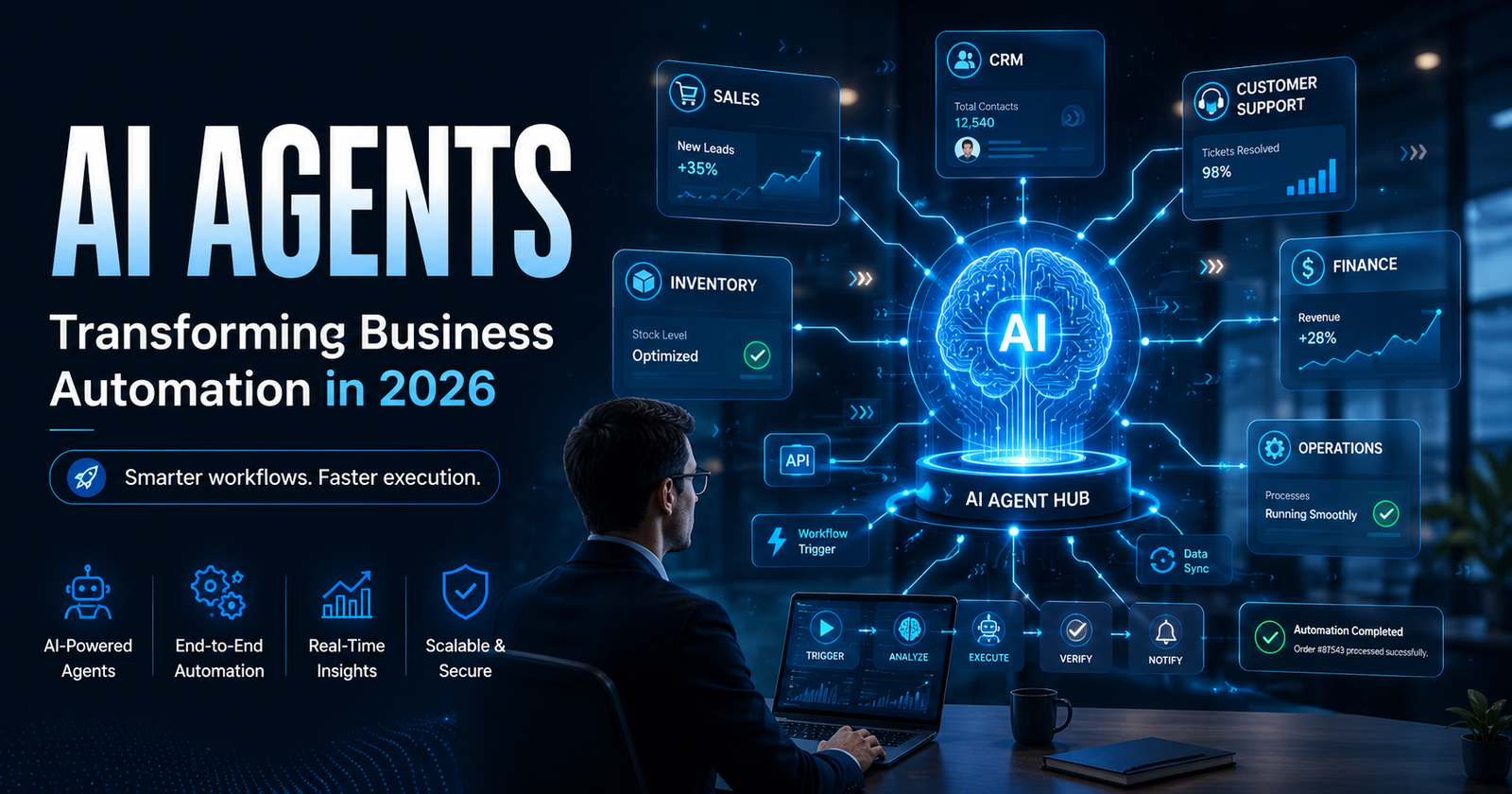
What Are AI Agents? How They’re Transforming Business Automation in 2026
The conversation around artificial intelligence has shifted dramatically. While the previous era focused heavily on static tools that generated text or answered prompts, 2026 marks the era of execution: agentic AI.
Businesses are moving beyond passive chatbots toward AI agents for business automation, which can understand goals, work with connected systems, and execute multi-step workflows with appropriate human oversight.
For growing companies, this transition unlocks a new level of operational speed, bridging the gap between basic task assistance and end-to-end process execution. Explore more in InnoFeature Labs tech insights.
What Are AI Agents?
An AI agent is an autonomous software entity driven by artificial intelligence that perceives its environment, makes contextual decisions, and executes multi-step tasks to achieve a specific business objective.
Instead of simply replying with text when prompted, an agent receives a broad instruction, formulates an execution plan, queries internal databases, interacts with external APIs, and completes the entire workflow without requiring continuous manual step-by-step guidance.
How Do AI Agents Work?
AI agents combine AI models, business data, APIs, and workflow rules to understand a goal, plan the required steps, use connected tools, and evaluate the results. Human approval can be added for sensitive or high-risk actions.
- Goal Acquisition: The agent receives a high-level instruction or event trigger.
- Context Retrieval: It queries integrated databases, enterprise CRMs, or live web tools for real-time information.
- Reasoning & Planning: The core model evaluates potential paths and breaks the goal down into sequential sub-tasks.
- Tool Execution: It triggers external APIs, updates software records, or routes communications.
- Feedback & Adjustment: The agent verifies the outcome of its actions and adjusts subsequent steps if an error occurs.
AI Agents vs. Chatbots vs. Traditional Automation
To build an effective strategy, it is critical to understand AI agents vs chatbots and how they differ from existing traditional business tools.
|
Capability |
Rule-Based Automation |
Conversational Chatbot |
Autonomous AI Agent |
|
Execution Trigger |
Strictly predefined rules (If/Then) |
Direct user text prompt |
Goal-oriented or event-driven |
|
Decision-Making |
Zero flexibility; fails on edge cases |
Text-generation based on training |
Dynamic, contextual reasoning |
|
Tool Usage |
Fixed integrations |
Limited or none |
Multi-system API & database access |
|
Adaptability |
None (Requires manual code changes) |
Low |
High (Adapts strategy dynamically) |
|
Workflow Scope |
Single isolated task |
Text interaction |
End-to-end multi-step operations |
|
Human Supervision |
Low |
Low |
Strategic / Human-in-the-loop guardrails |
Real-World AI Agent Use Cases for Businesses
Deploying AI agents for business can provide practical efficiency gains across various operational departments by automating repetitive and multi-step tasks.
1. AI Agents for Sales & Lead Qualification
Instead of manual data entry, AI agents for sales monitor incoming web inquiries, cross-reference prospect details against internal data sources, calculate lead scores, update your CRM, and send customized booking links to high-value leads.
2. AI Agents for Customer Service & Incident Escalation
Beyond answering simple FAQs, AI agents for customer service query tracking APIs, process refund requests within authorized limits, and route edge-case tickets directly to specialists with pre-summarized context.
3. AI Agents for CRM & Pipeline Automation
Using AI agents for CRM operations helps track deal progression inside your sales pipeline. If an enterprise lead becomes inactive, the agent drafts tailored follow-ups, schedules reminder tasks for account reps, and keeps deal values updated dynamically.
4. Finance & Invoice Processing
Financial agents can extract structured data from incoming vendor invoices, verify line items against existing purchase orders, prepare payment requests for human approval, and record approved transactions.
5. Inventory & Supply Chain Management
Supply chain agents continuously monitor warehouse stock levels. When an item crosses a minimum safety threshold, the agent calculates optimal order quantities, generates purchase orders, and emails vendor contacts automatically.
6. HR & Internal Operations
HR agents assist new hires through multi-stage onboarding processes—generating network credentials, sending compliance training materials, scheduling orientation calls, and resolving routine HR policy queries.
7. Software & IT Operations
IT operations leverage agents to monitor continuous server health, identify system vulnerabilities, recommend or prepare standard patches, and execute automated diagnostic scripts during technical downtime.
Benefits of AI Agents for Businesses
Implementing AI agents for small businesses and growing enterprises provides several core advantages:
- Operational Speed: Executes complex multi-system workflows in seconds rather than days.
- Cost Efficiency: Reduces hours spent on manual data entry and routine admin work.
- Continuous Availability: Operates 24/7 across critical operational touchpoints.
- Seamless Scalability: Expands operational capacity without requiring linear headcount growth.
- Improved Data Consistency: AI agents can reduce repetitive manual data entry and help keep information synchronized across connected business systems.
Where AI Agents Should NOT Work Alone
While AI agents are highly capable, fully autonomous operation is not suitable for high-risk business functions. Autonomous agents should strictly operate under human-in-the-loop guardrails in the following areas:
- High-Value Financial Transactions: Direct authorization of large wire transfers or payment releases.
- Critical Legal & Compliance Decisions: Drafting or signing legally binding enterprise contracts.
- Sensitive Personnel Actions: Managing HR terminations or disciplinary decisions.
- Core Cybersecurity Changes: Modifying primary network security protocols or root access rights.
AI Agents Human Employees: The Collaborative Model
The goal of implementing AI agents for small businesses and larger enterprises is not to replace human talent, but to augment human capability.
By offloading repetitive task execution to autonomous agents, human employees are freed to focus on high-level decision-making, creative problem solving, strategic vision, and building strong client relationships. The most effective enterprise deployments position AI agents as tireless digital assistants overseen by experienced human operators.
How to Start Using AI Agents in Your Operations
Transitioning toward business automation requires a structured approach:
- Identify Repetitive Bottlenecks: Pinpoint internal processes that consume high labor hours and rely heavily on manual copy-pasting across systems.
- Launch a Focused Pilot Project: Select a single low-risk workflow (e.g., lead routing or invoice capture) to test and measure performance.
- Establish Clear Guardrails: Set strict permission controls, expense caps, and mandatory human approval triggers.
- Integrate Core Systems: Connect your agentic frameworks directly with existing CRMs, ERPs, and database APIs through custom business software solutions.
- Measure & Iterate: Track operational speed, error reduction rates, and team hours saved before scaling to additional departments.
Build Your AI Automation Strategy
Navigating the shift toward AI automation requires clear planning and secure software integration. Whether you are seeking to streamline operational tasks or integrate agentic AI frameworks into your existing software stack, building a tailored solution ensures your business scales efficiently.
Ready to transform your business processes with custom software and automation solutions? Explore tailored technology strategies with InnoFeature Labs today.
About the Author
Syed Fahad Ali is the Founder & CEO of InnoFeature Labs, which helps companies bring manual processes to scale using digital solution. Having prior experience in Custom ERP Development, CRM, Inventory Management, AI Automation, and Business Process Automation, he has collaborated and assisted startups and growing businesses in creating software solutions that enhance efficiency, streamline processes, and facilitate long-term development and growth.


