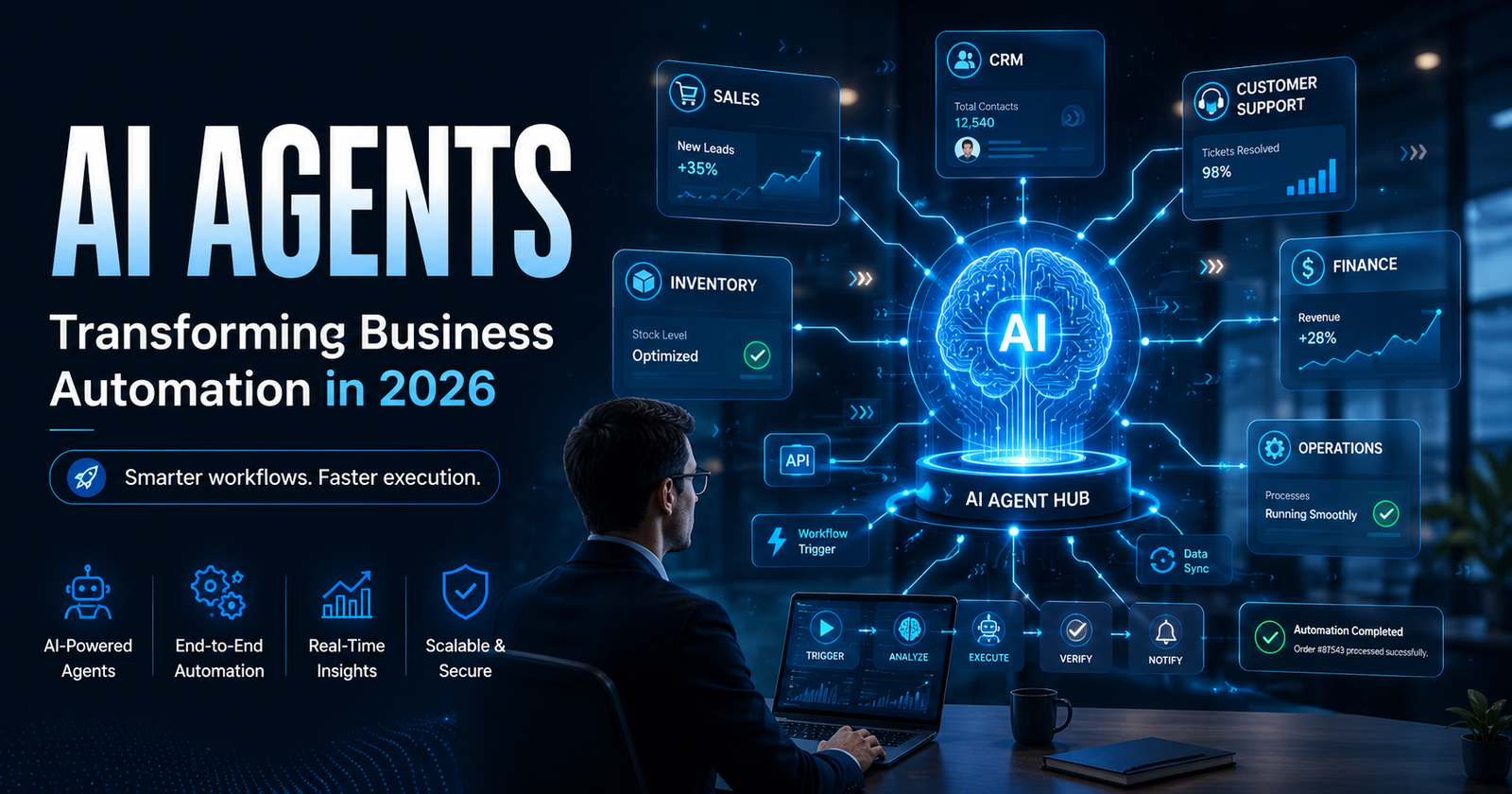
AI Agents for CRM: 7 Sales Workflows Businesses Can Automate in 2026
Sales teams spend a large part of their day on repetitive CRM activities: entering lead data, qualifying prospects, sending follow-ups, updating pipeline stages, scheduling meetings, and preparing reports. Traditional CRM automation can handle simple rule-based actions, but AI agents for CRM can understand context, decide what should happen next, and complete multiple steps across connected systems.
For many organizations, the strongest opportunity is not fully autonomous selling, but giving AI agents responsibility for repetitive steps that slow down representatives. This approach can improve consistency while keeping important customer decisions under human control in daily operations.
What Are AI Agents for CRM?
AI agents for CRM are intelligent software systems that can work with customer relationship management data and connected business tools. They can analyze information, make decisions according to business goals, perform actions, and respond to changing situations.
For example, when a new prospect enters a CRM, an AI sales agent can review the available information, evaluate lead quality, update the customer record, prepare a personalized follow-up, and alert the appropriate salesperson.
Businesses that are new to agentic technology can first explore What Are AI Agents? to understand how AI agents work across business processes.
AI Agents vs Traditional CRM Automation
Traditional CRM automation usually follows predefined rules. For example, a system may send an email whenever a lead submits a form.
AI agents in CRM can manage a broader workflow. They can examine customer information, identify intent, select an appropriate action, use connected tools, and complete several tasks toward a goal.
7 Sales Workflows AI Agents Can Automate
1. Lead Qualification and Scoring
Sales teams often receive more leads than they can immediately review. AI agents for sales can analyze information such as company size, industry, job role, website activity, previous interactions, and form responses.
The agent can assign a priority score based on business criteria and route high-value prospects to the right salesperson. Lower-priority prospects can enter an appropriate nurturing workflow.
2. CRM Data Entry and Updates
Keeping CRM records accurate can become a major administrative burden. Sales representatives may need to update contact information, meeting notes, opportunity stages, tasks, and customer interactions after every conversation.
An AI agent can extract relevant information from emails, forms, meeting notes, and connected systems, then update appropriate CRM fields.
For example, after a meeting, an agent could summarize the discussion, record customer requirements, update an opportunity, create a follow-up task, and notify the salesperson if human review is needed.
3. Automated Lead Follow-Ups
Consistent follow-up is essential, but sales representatives can easily miss prospects when managing large pipelines.
AI agents can monitor CRM activity and identify leads that need attention. Depending on approved rules, an agent can prepare personalized emails, schedule follow-up tasks, or notify a salesperson.
A workflow might look like this: a prospect downloads content, the AI identifies the topic of interest, reviews previous interactions, prepares a relevant message, and records the activity in the CRM.
4. Sales Pipeline Management
Sales managers need to know which opportunities are progressing, which deals are stalled, and where intervention may be required.
AI agents for CRM can continuously analyze pipeline information and identify opportunities that have been inactive, lack recent follow-ups, approach expected closing dates, or show changes in engagement.
Instead of manually checking every opportunity, managers can receive focused alerts and summaries that highlight where attention is most valuable.
5. Meeting Scheduling and Preparation
Scheduling sales meetings can involve emails, calendar checks, reminders, and CRM updates.
AI agents can coordinate approved scheduling workflows, identify suitable times, send communications, and record meeting activities. Before a meeting, an agent can also collect relevant customer information, previous conversations, open opportunities, and requirements from the CRM.
Afterward, the agent can summarize approved meeting notes and create follow-up tasks.
6. Customer Re-Engagement
Some prospects show interest but become inactive before making a purchase. AI agents can monitor CRM records and identify opportunities for customer re-engagement.
An agent can look for signals such as previous high engagement, inactive opportunities, unanswered communications, or renewed website activity. Based on defined rules, it can recommend or prepare a suitable follow-up.
This helps sales teams revisit valuable opportunities without manually searching through the entire CRM database.
7. Sales Reporting and Insights
Sales reporting often requires managers to review multiple CRM records before identifying important trends.
AI agents can analyze sales activity and generate summaries about pipeline performance, stalled opportunities, missing follow-ups, and upcoming deadlines.
A manager could ask, “Which opportunities need attention this week?” An AI agent can analyze available CRM information and return a focused response rather than requiring a manual review of every record.
Benefits of AI Agents for CRM
The value of AI agents goes beyond simple task automation. They can combine CRM data, business rules, and contextual analysis to support complete workflows.
Businesses can benefit from:
Less manual work: Agents can handle repetitive data entry, follow-ups, scheduling, and reporting.
Faster lead response: Automated qualification and routing can help sales teams act on promising prospects sooner.
Better CRM data: Automated updates can reduce incomplete or outdated records.
Higher productivity: Sales representatives can spend more time with customers instead of administrative tasks.
Scalable operations: AI agents can support growing lead and customer volumes without requiring every task to be performed manually.
For organizations expanding automation across departments, Business Automation Solutions can provide a broader view of how intelligent workflows can support operations.
Should AI Agents Replace Sales Teams?
AI agents should generally support sales professionals rather than replace them. Human involvement remains important for relationship building, complex negotiations, strategic decisions, sensitive conversations, and high-value opportunities.
A practical model is human plus AI collaboration. Agents manage repetitive and structured tasks, while sales representatives handle situations that require judgment, empathy, creativity, and business experience.
Security is also important. Businesses should define permissions, protect customer information, and control which actions agents can perform. AI Agent Security Best Practices covers important safeguards for autonomous systems.
How to Implement AI Agents in CRM
Businesses should begin with one measurable workflow instead of trying to automate the entire sales process immediately.
Start by identifying repetitive tasks with clear outcomes. Connect the agent only to the data and tools it needs. Define permissions and approval requirements. Test the workflow with controlled scenarios, measure results, monitor errors, and expand gradually.
Organizations should also monitor agents after deployment. AI Agent Observability can help teams track behavior and identify production problems.
Summary
AI agents for CRM are changing how businesses approach sales workflow automation in 2026. They can support lead qualification, CRM data entry, follow-ups, pipeline management, meeting scheduling, customer re-engagement, and sales reporting.
By combining AI with CRM automation, businesses can reduce repetitive work, improve response times, maintain better customer records, and give sales teams more time for valuable customer interactions.
Businesses moving away from spreadsheets can also explore Why Growing Businesses Are Replacing Excel to understand the value of centralized business software.
Conclusion
AI agents for CRM represent a major step beyond traditional rule-based automation. Instead of simply triggering predefined actions, they can interpret information, make contextual decisions, use connected tools, and complete multi-step sales workflows.
The seven workflows discussed provide practical starting points for businesses exploring AI sales automation. However, successful implementation requires more than connecting an AI model to a CRM. Businesses need reliable data, secure integrations, clear permissions, human oversight, and continuous monitoring.
The best approach is to start with a high-volume workflow, measure its results, and then expand automation gradually. When implemented responsibly, AI agents can help sales teams reduce administrative work, improve lead management, and focus more effectively on building customer relationships.
About the Author
Syed Fahad Ali — Founder & CEO, InnoFeature Labs
Syed Fahad Ali is the Founder & CEO of InnoFeature Labs, working across custom ERP development, CRM, inventory management, AI automation, and business process automation. He helps startups and growing businesses use practical software solutions to streamline operations, improve efficiency, and build scalable digital systems.