

Monolithic vs. Microservices Architecture: Which Is Right for Your Software Project?
Choosing the right software architecture can affect how easily an application is developed, maintained, scaled, and improved. For startups, SaaS companies, and growing businesses, one of the most important decisions is often monolithic vs microservices.
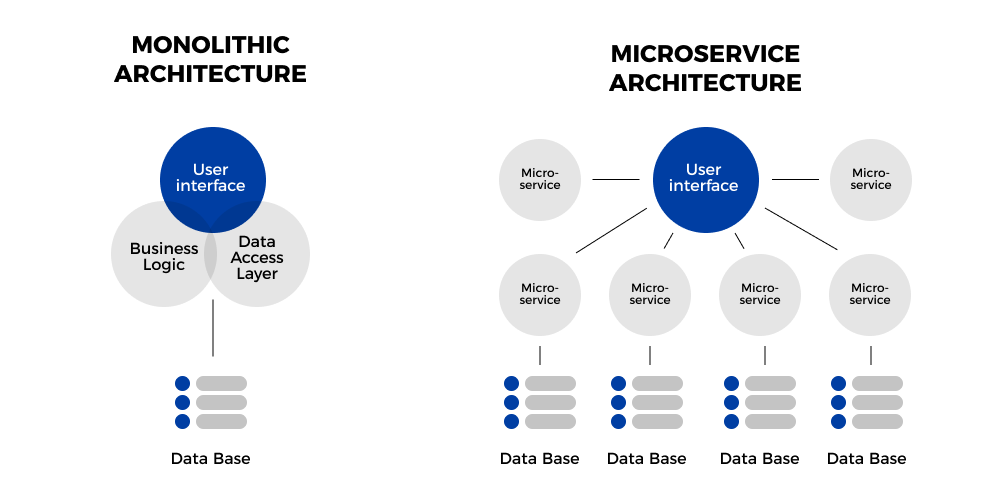
A monolithic architecture keeps an application's core functionality within one deployable application, while microservices architecture divides the system into smaller services that can be developed and deployed independently.
Neither approach is automatically better. The right choice depends on your application size, development team, scalability requirements, budget, and long-term business goals.
What Is Monolithic Architecture?
Monolithic architecture is a software architecture where the major components of an application are developed and deployed as one application.
For example, a business platform might contain:
- User authentication
- Customer management
- Orders
- Payments
- Reporting
- Notifications
These components can be organized into separate modules but are generally delivered as a single deployable system.
Benefits of Monolithic Architecture
Faster initial development: A single codebase can make it easier for a small team to build and test an application.
Simpler deployment: The application can usually be deployed as one unit instead of coordinating multiple services.
Lower operational complexity: Smaller projects may require fewer infrastructure and DevOps components.
Simpler debugging: Developers can often trace functionality within one application without dealing with multiple network calls.
For startups and smaller software projects, these advantages can make monolithic architecture a practical starting point.
What Is Microservices Architecture?
Microservices architecture divides an application into smaller, independently managed services. Each service typically handles a specific business capability.
For example, a SaaS platform could have separate services for:
- Authentication
- Customer management
- Billing
- Inventory
- Notifications
- Analytics
- Individual services can potentially be developed, deployed, and scaled independently.
This makes microservices attractive for large applications with complex business requirements and multiple development teams.
Monolithic vs Microservices: Key Differences
The main difference between monolithic vs microservices architecture is how application components are organized, deployed, and scaled.
|
Factor |
Monolithic Architecture |
Microservices Architecture |
|
Structure |
Single application |
Multiple services |
|
Deployment |
Usually one deployment |
Services can deploy independently |
|
Scaling |
Application-level scaling |
Individual service scaling |
|
Complexity |
Lower initially |
Higher |
|
Infrastructure |
Simpler |
More complex |
|
Team structure |
Good for smaller teams |
Useful for larger teams |
|
Best suited for |
Startups, MVPs, small/medium apps |
Large SaaS and enterprise platforms |
The important point is that architecture should support the business rather than introduce unnecessary complexity.
Advantages of Microservices Architecture
1. Independent Scaling
One major benefit of microservices is independent scaling.
For example, an e-commerce platform may receive much more traffic on product search than reporting. With microservices, the search service can potentially be scaled independently instead of scaling the entire application.
2. Independent Deployment
Development teams can deploy individual services without necessarily redeploying the complete platform. This can be valuable for larger teams working on different business functions.
3. Clearer Service Boundaries
Services can be designed around specific business capabilities. For example, a payment service can focus on billing while an inventory service manages stock.
4. Better Fit for Large Platforms
Large SaaS platforms and enterprise applications may benefit from microservices when their domains, teams, workloads, and deployment requirements become sufficiently complex.
Disadvantages of Microservices Architecture
The biggest mistake is assuming that microservices are always better because they are more modern.
Microservices introduce additional technical and operational complexity, including:
- Service-to-service communication
- Distributed logging and monitoring
- Authentication between services
- Network failure handling
- Deployment automation
- Container orchestration
- Data consistency
- API or messaging management
- For a small application, this complexity may provide little benefit.
Therefore, microservices vs monolith should be treated as a business and engineering decision, not simply a technology trend.
Monolithic Architecture vs Microservices: Which Is Easier to Scale?
Both architectures can scale, but they approach scaling differently.
A monolithic application can be scaled by increasing resources or running additional application instances.
Microservices allow individual components to scale separately. This can be useful when different parts of an application have very different workloads.
However, microservices do not automatically make an application faster. Database design, caching, network communication, infrastructure, and application code all influence performance.
A well-designed monolith can sometimes be simpler and more efficient than a poorly designed microservices system.
Monolithic vs Microservices for Startups
For startups, choosing between monolithic vs microservices for startups requires careful consideration.
Early-stage companies usually need to validate their product quickly. Requirements may change frequently, development teams may be small, and infrastructure budgets may be limited.
A modular monolith can therefore be an effective option.
A modular monolith keeps the application as one deployable system while separating major business functions into logical modules.
For example:
Customer Module → Orders Module → Payments Module → Reporting Module
As the product grows, individual modules can later be evaluated for migration to separate services when there is a real technical or business reason.
When Should You Choose Monolithic Architecture?
A monolithic architecture may be appropriate when:
- You are building an MVP
- Your application is small or medium-sized
- Your development team is small
- You need a fast initial launch
- Requirements are still changing
- Infrastructure should remain simple
- Independent service scaling is not currently required
For many startups, a modular monolith can reduce unnecessary complexity while allowing future architectural evolution.
When Should You Choose Microservices Architecture?
When to use microservices architecture depends on the complexity and maturity of your application.
Microservices may be appropriate when:
- Your application has multiple complex business domains
- Different teams need independent ownership
- Individual services have different scaling requirements
- Independent deployments are important
- Your organization has strong DevOps capabilities
- The platform requires greater service-level isolation
- A single application has become difficult to manage
Microservices should be introduced because the system needs them—not simply because they are popular
Can You Move From Monolith to Microservices?
Yes. A growing application can gradually move from a monolithic architecture toward microservices.
A common strategy is to identify one business capability with a clear boundary and extract it first.
For example, a SaaS application could begin as a monolith and later separate:
Notification Service → Search Service → Billing Service → Analytics Service
This gradual approach can reduce migration risk compared with rebuilding the entire platform at once.
Migration requires careful planning around databases, service communication, authentication, testing, monitoring, deployment, and data consistency.
How to Choose the Right Software Architecture
Before deciding between monolithic vs microservices architecture, ask:
1. How complex is the application?
Small applications usually benefit from simpler architecture.
2. How large is the development team?
Microservices require stronger coordination, DevOps, testing, and monitoring practices.
3. Do different components need independent scaling?
If yes, microservices may provide a meaningful advantage.
4. How important is rapid development?
If speed-to-market is the priority, a modular monolith may be the better starting point.
5. What are your long-term requirements?
Architecture should support realistic growth without creating unnecessary complexity today.
Conclusion
The monolithic vs microservices decision is not about choosing the most fashionable architecture. It is about choosing the right architecture for your software project's requirements and future direction.
A monolithic architecture can provide simplicity, faster development, and lower operational overhead for startups, MVPs, and smaller applications. Microservices can become valuable when an application grows into a complex platform with multiple business domains, teams, workloads, and deployment requirements.
For many businesses, a well-designed modular monolith can provide a strong foundation while leaving a practical path toward microservices when the business actually needs them.
The goal should always be scalable software architecture without unnecessary complexity.
About the Author
Syed Fahad Ali — Founder & CEO, InnoFeature Labs
Syed Fahad Ali is the Founder & CEO of InnoFeature Labs, working across custom ERP development, CRM, inventory management, AI automation, and business process automation. He helps startups and growing businesses use practical software solutions to streamline operations, improve efficiency, and build scalable digital systems.


